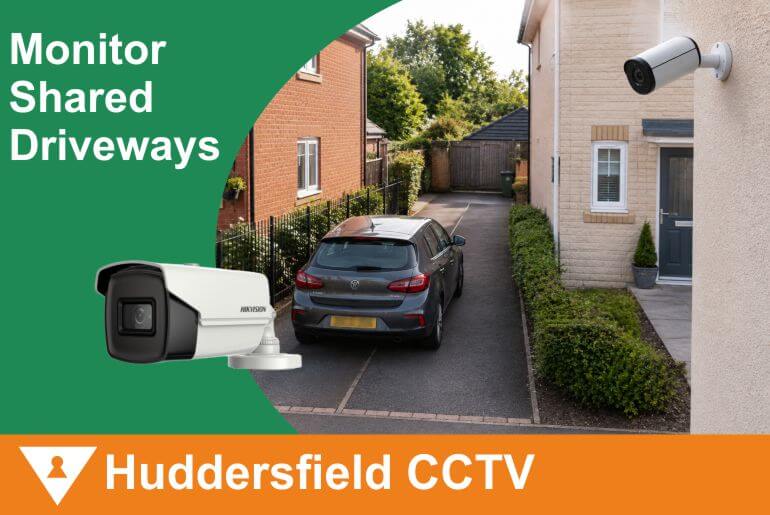
CCTV to monitor shared driveways –
Shared driveways, private access roads and rights of way are common features of many residential properties. Most of the time they work perfectly well, but when an issue does arise, establishing exactly what happened can be surprisingly difficult.
A vehicle may repeatedly block access. A gate could be left open. Delivery drivers might use the wrong entrance. Damage can appear on a wall, fence or driveway without anyone knowing who caused it. In these situations, professionally installed CCTV can provide homeowners with something particularly useful: an objective record of events.
Across Huddersfield, the variety of residential properties means shared access arrangements take many forms. Older terraces may have narrow rear access routes, larger detached properties can share private lanes, and converted buildings sometimes have parking areas used by several households.
CCTV can help homeowners understand activity around these spaces without relying solely on memory or conflicting accounts.
Parking disputes provide an obvious example. If a vehicle regularly prevents access to a driveway, recorded footage can establish when the problem occurs and how frequently. This is considerably more useful than trying to remember individual incidents over several weeks.
Accidental property damage is another situation where recordings may help. A delivery vehicle reversing into a gatepost or a contractor clipping a wall can cause significant damage even at low speeds. If nobody witnesses the incident, CCTV may provide the only clear explanation of what occurred.
Private lanes can experience problems with vehicles using them as convenient turning points. An occasional driver doing so may be insignificant, but repeated use by larger vehicles can contribute to damage to verges, gravel surfaces or boundary features.
A carefully positioned camera can help establish whether this is happening and at what times.
However, shared access creates important considerations when designing domestic CCTV.
The objective should be to protect your property and legitimate interests without unnecessarily monitoring neighbours. Cameras need to be positioned carefully so they concentrate on relevant entrances, boundaries and areas of private property wherever practical.
Professional CCTV design is particularly valuable in these situations because simply choosing the widest possible viewing angle is not necessarily the best solution. A more focused camera position can often provide the evidence required whilst reducing unnecessary coverage beyond the property.
Image quality matters too. A distant overview showing that a vehicle entered an access road may be less useful than a properly positioned camera providing sufficient detail to establish what happened. Modern high-definition CCTV offers significantly better clarity than older systems, particularly when suitable equipment is matched to the location.
Night-time visibility should also be considered. Many access problems occur after dark when residents return from work, taxis arrive or delivery drivers make evening calls. CCTV should therefore provide useful recordings throughout changing lighting conditions rather than performing well only during daylight.
Remote viewing adds another practical benefit. Homeowners can check whether access is clear before arriving home or confirm what is happening if a neighbour reports an issue while they are away.
Recorded footage can also remove unnecessary suspicion.
If damage appears near a shared driveway, it is easy to assume another resident was responsible. CCTV may show that the cause was actually a courier, contractor or completely unrelated vehicle. Establishing facts quickly can prevent minor incidents from developing into unnecessary disagreements between neighbours.
CCTV should not be viewed as a tool for policing every movement around a shared space. Its value comes from providing reliable information when something unusual or problematic occurs.
For Huddersfield homeowners with shared driveways, private lanes or complicated access arrangements, professional CCTV can therefore serve a slightly different purpose from conventional home surveillance.
It still contributes to security, but it can also provide clarity.
When several people regularly use the same access area, knowing exactly what happened can be far more useful than wondering who was responsible.