CCTV AI Detection Guide –
One of the biggest frustrations with older CCTV systems was the number of unnecessary notifications they generated. Leaves moving, headlights flashing past or a cat walking across a driveway could all trigger recordings and alerts.
Modern CCTV technology has changed significantly. One of the most common questions homeowners now ask is: can smart CCTV cameras actually tell the difference between people, vehicles and animals?
In most modern systems, the answer is yes.
For Huddersfield homeowners, this smarter detection technology has become one of the biggest improvements in domestic CCTV systems because it dramatically improves both usability and reliability.
How older CCTV systems worked
Traditional motion detection simply looked for:
- Pixel changes on screen
- General movement within an area
This meant almost anything could trigger recording, including:
- Rain
- Trees moving in wind
- Shadows
- Wildlife
- Vehicle lights
The result was:
- Endless notifications
- Wasted storage space
- Important events becoming harder to find
How smart CCTV detection works
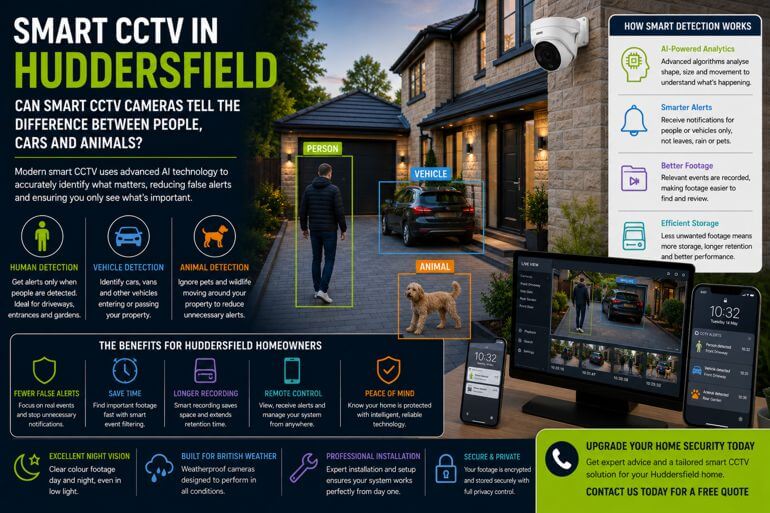
Modern CCTV systems use advanced analytics to identify:
- Human shapes
- Vehicle movement
- Animal activity
Rather than just detecting “motion”, the system analyses the object itself.
This allows cameras to:
- Trigger alerts only for people
- Ignore animals if required
- Separate vehicle events from pedestrian activity
Why this matters for homes in Huddersfield
Domestic environments generate constant movement.
Without smart detection, homeowners may receive:
- Dozens of unnecessary alerts daily
- Notifications triggered by pets
- Footage cluttered with irrelevant recordings
Smart CCTV reduces this dramatically by ensuring the system focuses on what actually matters.
Can CCTV detect vehicles separately?
Yes.
Modern systems can identify:
- Cars entering driveways
- Vehicles stopping outside properties
- Movement within defined vehicle zones
This is particularly useful in Huddersfield homes with:
- Larger driveways
- Multiple vehicles
- Detached garages or rear access parking
What about pets and wildlife?
Modern smart CCTV can usually distinguish:
- People
- Cats and dogs
- Small wildlife
This means homeowners can reduce unnecessary alerts caused by pets moving around gardens or driveways.
Does smart detection improve recording quality?
The image quality itself remains separate, but smart detection improves:
- Event filtering
- Searchability
- Efficiency of recordings
Instead of scrolling through hours of footage, users can search specifically for:
- Human activity
- Vehicle movement
This makes systems much easier to use day-to-day.
Do smart CCTV systems still record continuously?
They can — but many homeowners now prefer:
- Motion-based smart recording
- AI-filtered event recording
This helps:
- Extend storage retention
- Reduce unnecessary footage
- Simplify playback and review
Are smart CCTV cameras more expensive?
Generally, yes — but the benefits are significant.
Most homeowners find the improved:
- Accuracy
- Convenience
- Reduction in false alerts
more than justifies the additional cost.
Does camera positioning still matter?
Absolutely.
Even smart cameras perform poorly if:
- Positioned incorrectly
- Pointed into bright light
- Mounted too high or low
Professional positioning remains critical for reliable performance.
Final Answer: Can smart CCTV cameras tell the difference between people, cars and animals?
Yes — modern smart CCTV systems can accurately distinguish between:
- Humans
- Vehicles
- Animals
For homeowners in Huddersfield, this means:
- Fewer false alerts
- More relevant notifications
- Easier footage review
- Better overall security performance
CCTV AI Detection Guide
Modern CCTV is no longer just recording movement — it is intelligently identifying what matters most.